
Parentification: Why Rest Feels Dangerous
First, some personal testimony:
Growing up, I can remember a very clear knowing that my parents were not well-enabled to lead themselves or others.
There was substantial trauma upstream from them that had gone unacknowledged and unaddressed.
Their intentions were good. But their personal development was still underway, unconsciously taking priority at times.
After attempting to move towards my parents for a sense of safety in connection, I rebelled and eventually turned inward, looking for stability that I could not dependably find outside of myself.
Acts of defiance were masked calls for support.
I needed to stay a kid for long enough to learn the lessons of childhood.
I needed to stay a boy in order to become a man.
Instead, the psychological and emotional unpredictability of my parents led to a choice; maintain my innocence under their unpredictable leadership or become a parent to them and myself.
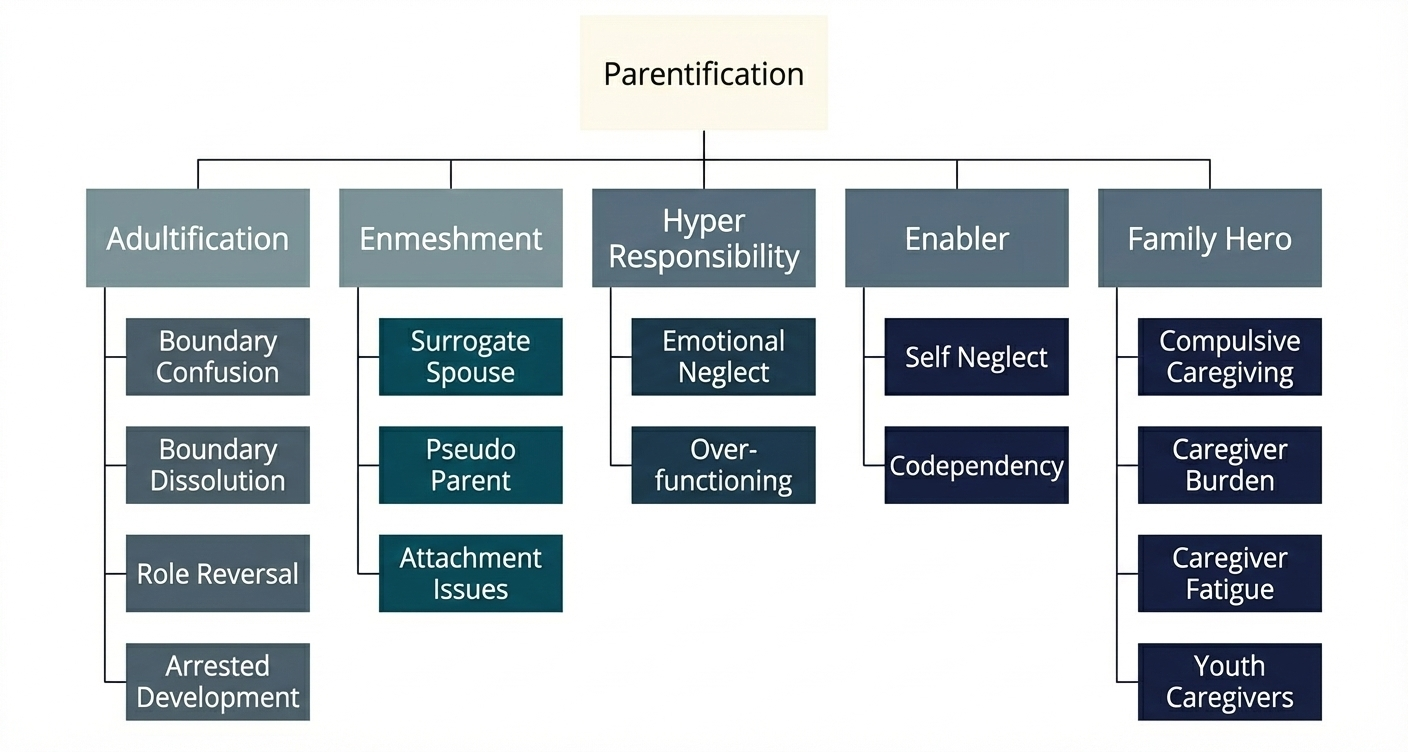
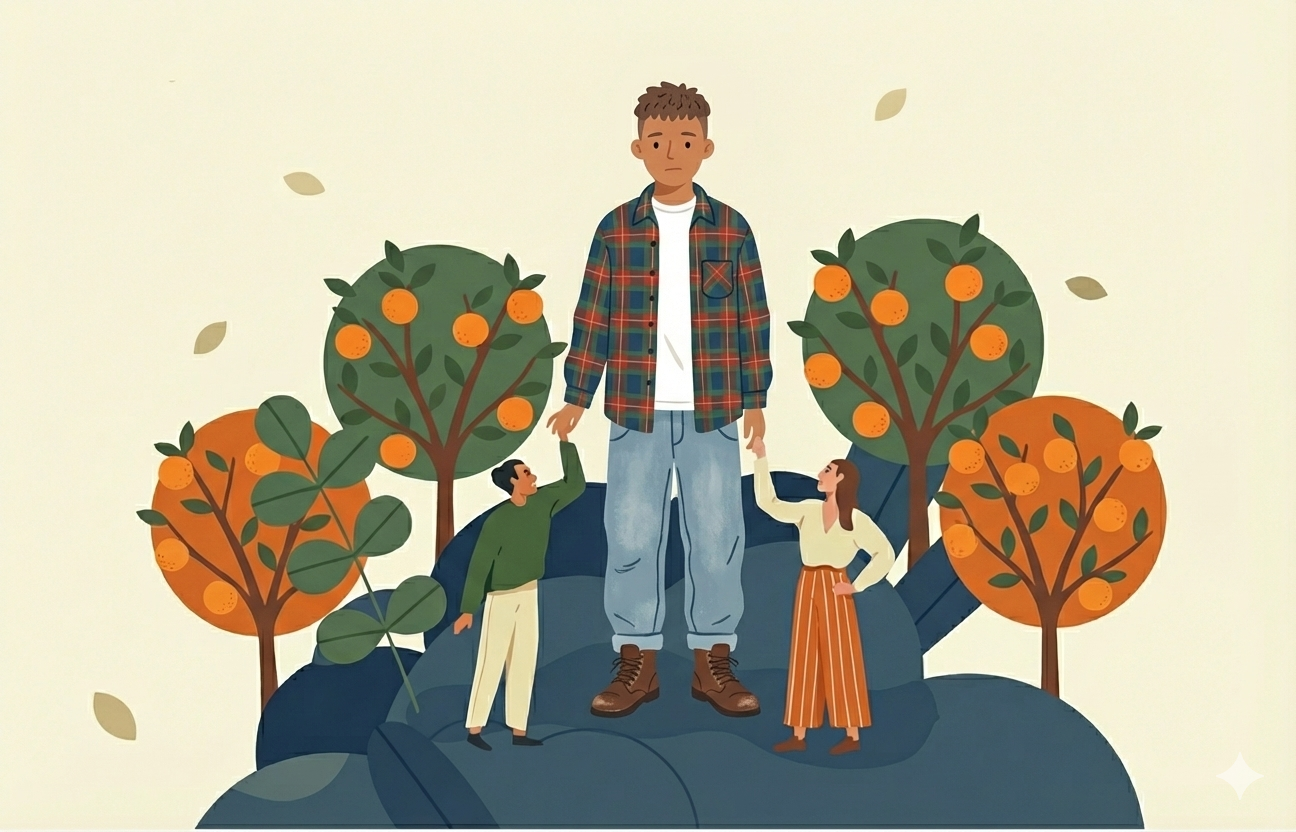
If you’ve ever felt like you were born a forty year old, then you may be living with the legacy of parentification. This happens when a child is raised into adulthood before they’re emotionally and cognitively ready. This disrupts attachment, our sense of ourself and our ability to authentically connect. There are many terms that form as a constellation underneath parentification. And many of these terms role into each other. Some will speak to unique experiences which aren’t associated with other terms. My hope in you reading this is that you build awareness rather than feel pathologized. So let us begin…
Adultification
Adultification happens when children are treated as small adults, being expected to handle responsibilities, information, and emotional content beyond their developmental capacity. It's a sign of a collapsing generational hierarchy; the result being a child who is prematurely exposed to adult burdens. Through a trauma-informed lens, this would fit the phrase, “too much, too fast, too soon.”
Boundary Confusion is an erosion of clarity between the parent and child worlds. A mother shares her marital frustrations with her child, or a father shares work stress and financial anxieties with his teenager. The child receives information without the ability to process or resolve it, creating angst and hypervigilance.
Boundary Dissolution takes boundary confusion further. The line between parent and child effectively disappears. The child becomes privy to everything: parental conflicts, family debt and housing instability, substance abuse/dependance, adultery, and/or emotional breakdowns. Where there was some semblance of boundaries before, now there is no protected space for childhood innocence to remain.
Role Reversal is a natural response to boundary confusion and disillusion. The child becomes the functioning parent, managing household logistics, mediating parental conflicts, providing emotional regulation that the adults cannot provide for themselves. This is different from the pseudo parent as I will elaborate on below.
Arrested Development is the inevitable consequence. When children are required to function as adults, they lose access to the developmental tasks of childhood: play, exploration, identity formation, and gradual skill-building. Parts of them remain frozen at the age when they were recruited into adult service, creating a painful paradox for adults to feel simultaneously ancient and developmentally childlike.
Enmeshment
Enmeshment is disguised as love. It feels like closeness, a special connection or being chosen. It looks like you’re your parent’s best friend. But underneath, enmeshment is a form of psychological colonization where the child’s sense of self is gradually absorbed into the parent's emotional ecosystem. Eg. a son whose sense of self is lost to the devouring maternal figure, a Jungian archetype.
And similar to enmeshment, a Surrogate Spouse dynamic, which can emerge when a parent in an emotionally distant or conflicted marriage turns to their child for the companionship and emotional attunement they're not receiving from their partner. The child becomes a confidant and the one who truly ‘understands’ the parent. This can be a profoundly violating experience when attempting to development boundaries and a security in one’s sense of self.
The Pseudo Parent role activates when the child assumes parenting functions for siblings or the household. They become the one who remembers appointments, manages logistics, soothes distressed family members, and holds the family system together through their competence. The key difference between role reversal and the pseudo parent role is that the pseudo parent isn't parenting the parent, but rather is deputized by the parent to extend parental control. They become an arm of the parental system rather than a replacement for it.
Attachment Issues inevitably follow. Children raised in enmeshed systems struggle to develop secure attachment because the parent's needs consistently override their own. They learn that love means sacrifice, that closeness requires self-abandonment, and that having needs of their own threatens connection. In adulthood, their behavior may swing between clinging and avoidant withdrawal, never having learned what healthy interdependence feels like (a capacity to need others and be needed by them without losing yourself in either direction).
Hyper-Responsibility
Some children (typically Highly Sensitive Person’s or HSPs) develop a sense of responsibility through absorbing the family's unspoken needs. They become the child who never needed anything or who handles their own problems so the adults don't have to.
Emotional Neglect often underlies this pattern. When parents are absent, whether physically, emotionally or functionally, children fill the vacuum. They learn that their emotional needs will not be met, so they stop acknowledging them. Or more accurately, an internal divide is created between the performing self and the suffering self. This is what we work towards unburdening and integrating in therapy.
Over-functioning becomes the organizing principle of our growing personality structure. Our nervous system has been calibrated for constant surveillance and performance. Rest feels dangerous. Needing anything feels like failure resulting in shame. These adults may be accomplished by every worldy measure while internally running on fumes. In this state, worthiness can be entirely dependent on productivity and usefulness to people or to systems.
The Enabler
Enablers can develop in family systems where addiction, mental illness, abuse, or chronic conflict requires active management. The enabler child learns to smooth over problems, make excuses and maintain appearances.
Self-Neglect is the enabler's defining feature. Their own needs, feelings, and personal development becomes secondary to the project of managing the family dysfunction. They may not even recognize they have needs, having learned so early to suppress them in service of the system’s maintenance.
Codependency emerges as an adult relational template. Enablers become experts at the reading of other’s moods and needs, preventing crises and managing emotions. This expertise comes at the cost of knowing themselves. In adult relationships, they may unconsciously seek out partners who need managing, recreating the familiar dynamic where their value lies in fixing, helping and sacrificing.
The Family Hero
The Family Hero presents the most socially acceptable face of parentification. These are the high achievers, the gifted ones, the success stories; those who "made it out.” But beneath the accomplishment lies an exhausted child who learned that their worth depends on achievement as a form of value that can be exchanged for love.
Compulsive Caregiving often accompanies the hero role. These children take care of siblings, parents and extended family while also excelling academically, athletically or professionally. They're the ones who make the family look good, who provide hope and who ‘prove’ that everything is okay (even when it isn't).
Caregiver Burden compounds over time, accumulating invisibly. Because helpers are so competent, no one notices they're struggling. Helpers and healers learned to never need help, so they just don't ask for it. That hidden struggle can break through in the form of medical diagnosis like autoimmune issues and chronic nervous system collapse as we’ll identify in the next term.
Caregiver Fatigue eventually arrives. The helper’s nervous system, having never been allowed to not run in performance mode, begins to break down. They may experience burnout, health crises, or an existential crossroads: "If I stop providing, who am I? How is one who doesn’t ‘give’ lovable?" Even though this may feel incredibly unsettling to read (as it is to write), this can be viewed as an invitation to begin the journey of self inquiry because now you have access to good guidance and supportive community.
Youth Caregivers are children who provide actual caregiving to ill, disabled, or impaired parents. This represents a particularly intense version of this pattern. These children sacrifice their childhood in immediate, concrete ways, often while being praised for their maturity and selflessness. The praise itself unintentionally becomes a form of harm, reinforcing that their value lies in their service rather than their being.
The Path Forward
Healing isn't about erasing your history or the skills you’ve developed, but rather an ability to act decisively and instinctively without self-abandonment.
You have a profound capacity to empathize and emotionally discernment, which comes with this territory. All of that wisdom is underneath, waiting to be expressed rather than required. And compassionately tapping into that may be your only next indicated step.
-Ryan
If this resonates with you, I specialize in working with high-functioning adults whose nervous systems learned to perform, provide, or mask. Through attachment-based, trauma-informed therapy, we will help you to experience rest as safe.